
The fish meal machine production line can process fresh fish or fish processing waste into high-protein fish meal and fish oil, helping businesses improve resource utilization and reduce raw material waste. It is widely applied in feed production, aquaculture, and animal protein recycling industries. Production capacities range from 1–5 tons/day, 10–50 tons/day, 50–100 tons/day, 100–250 tons/day, and even larger capacities for industrial-scale production.
Suitable raw materials include fresh fish, fish heads, fish bones, fish viscera, fish skin, and other fish by-products. Through crushing, cooking, pressing, drying, and grinding processes, the machine efficiently converts fish materials into valuable products while maintaining stable processing performance.
The finished fish meal is rich in protein and widely used for poultry feed, livestock feed, and aquatic feed production, while fish oil extraction creates additional economic benefits. With flexible output options and efficient recycling capability, the fish meal machine offers a practical solution for modern fish processing and feed manufacturing businesses.
Fish meal machine raw materials and final products
The fish meal machine is to process seafood materials into valuable fish meal and fish oil, improving raw material utilization and creating higher economic value. It is suitable for feed plants, aquaculture farms, and animal protein processing industries.
Suitable raw materials:
- Fresh fish
- Shrimp
- Crab
- Seafood processing waste
- Other marine by-products
Final products:
- Fish meal (high-protein feed ingredient)
- Fish oil (for further industrial and feed applications)
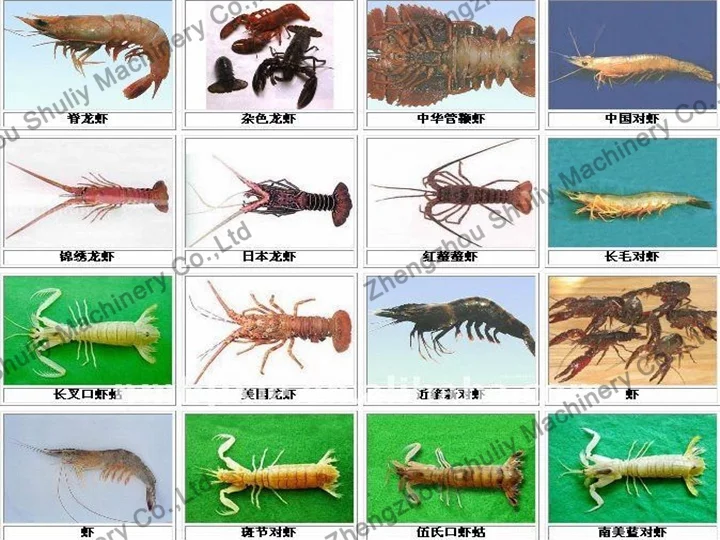
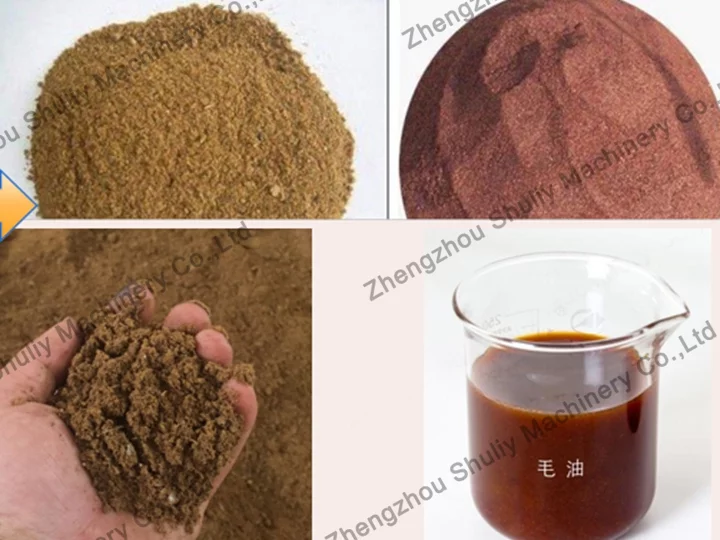
With efficient processing technology, the fish meal machine helps businesses convert seafood resources into profitable products while reducing waste and improving production efficiency.
The whole working process of the fish meal making machine plant
The fish meal production plant converts raw fish into high-quality fish meal and fish oil through a continuous, multi-stage process using specialized equipment. The entire workflow, from raw material handling to final packaging, is as follows:
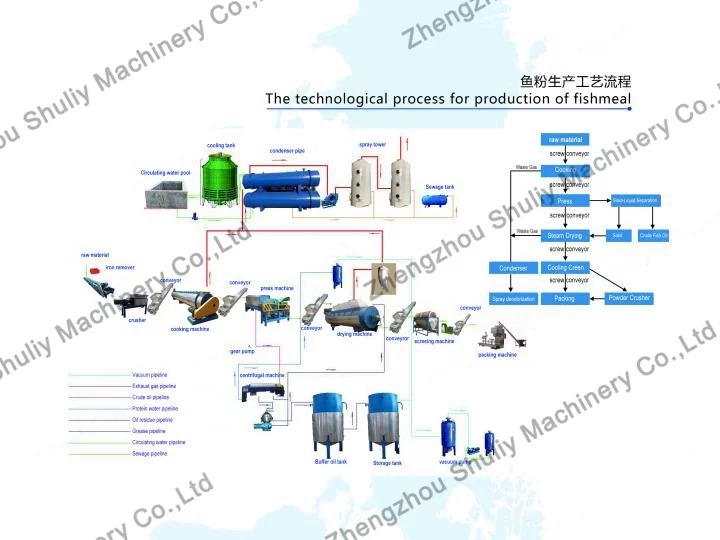
Raw Material Preparation
In the raw material preparation stage, the fish crusher is used to process fish scraps, fresh fish, shrimp, mealworms, and similar materials into small particles of ≤5mm, ensuring they are suitable for further processing. This step helps improve cooking and processing efficiency in the production line.
For materials that are already small in size, this crushing step can be omitted. In such cases, the raw materials can be directly conveyed to the fish cooker through a screw conveyor, simplifying the process and saving energy and time.
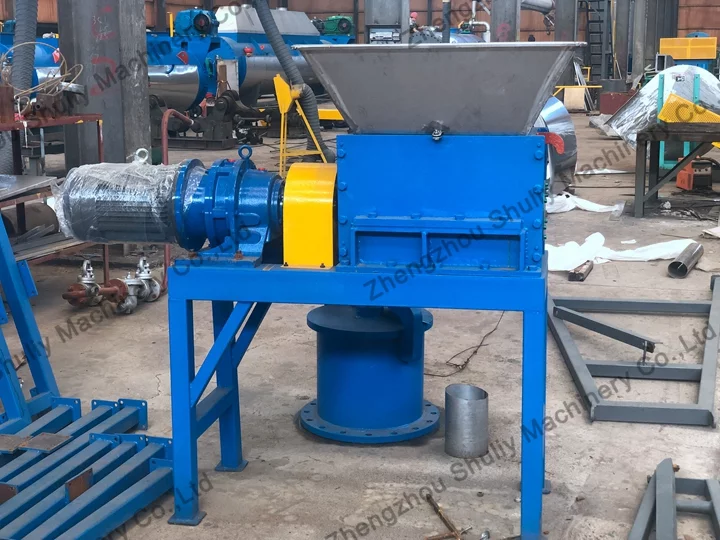
| Capacity | 500–1000 kg/h |
| Power | 5.5 kW |
| Dimension (L×W×H) | 1200 × 600 × 1000 mm |
| Weight | 300 kg |
| Machine Shell Material | Stainless steel |
| Knife Material | 40Cr steel |
| Feeding Structure | Upper collecting hopper |
| Hopper Material | SUS304 stainless steel |
Cooking (Cooking Machine)
The cooking machine is the core of the initial processing stage, using high-temperature steam to cook fish materials, sterilize them, soften tissues, and denature proteins to improve oil and moisture removal efficiency. The cooking time is about 20 minutes, with a working temperature of 150℃–160℃.
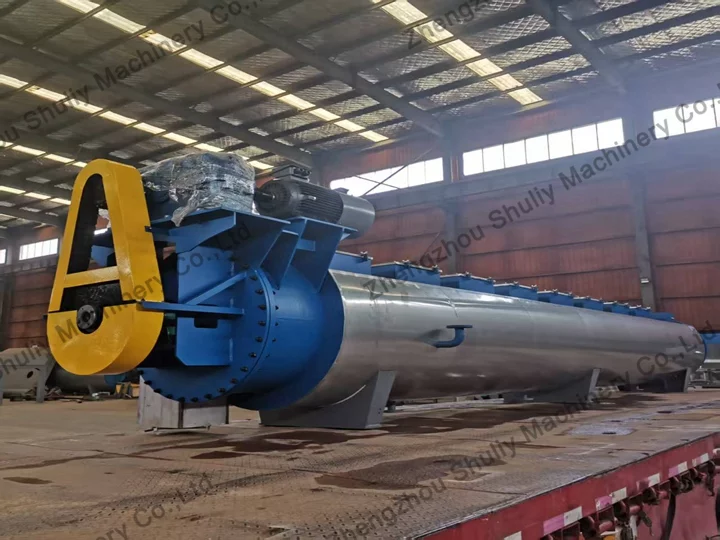
| Model | Tank Diameter (mm) | Tank Length (mm) | Steam Consumption (0.6MPa, kg/h) | Production Capacity (t/h) | Motor Power (kW) |
|---|---|---|---|---|---|
| LZ400 | 400 | 6000 | 250 | 1.5 | 2.2 / 3 |
| LZ500 | 500 | 6000 | 350 | 2.5 | 3 / 4 |
| LZ600 | 600 | 7000 | 500 | 4 | 4 / 5.5 |
| LZ700 | 700 | 8000 | 650 | 6 | 5.5 / 7.5 |
| LZ800 | 800 | 8000 | 750 | 8 | 7.5 / 11 |
Pressing (Press Machine)
The cooked fish is fed into the press machine, which separates it into solid press cake and liquid phase containing water, fish oil, and soluble proteins. This is the key step for efficient oil-water separation and fish meal formation.
The liquid is discharged as an oil-water mixture, while the solid is output as crude wet fish meal. The screw press features an 18mm screw diameter and 12mm spiral blade made of 16MnR, with a 304 stainless steel outer cover and receiving tank for durability and corrosion resistance. A fish oil separator can be optionally equipped to improve oil recovery.
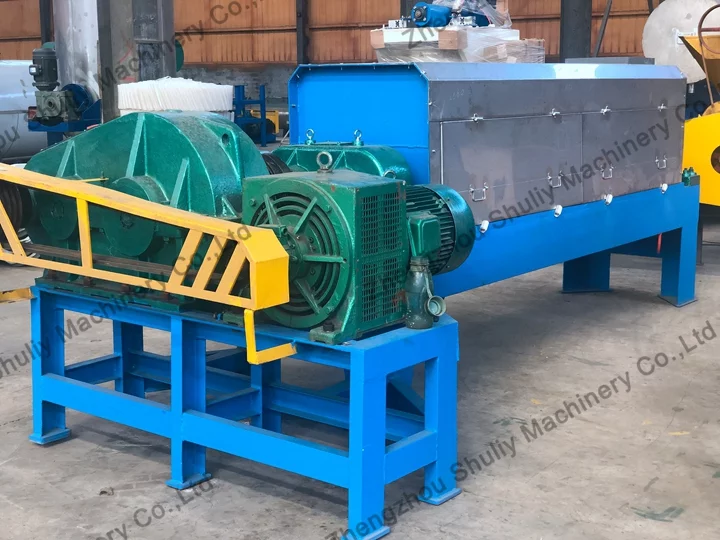
| Model | Cylinder Size (mm) | Production Capacity (t/h) | Power (kW) | Reducer Model |
|---|---|---|---|---|
| LY300 | Φ300×1600 | 1.5 | 15 | ZQ500 |
| LY400 | Φ400×1800 | 2 | 18.5 | ZQ500 |
| LY500 | Φ500×2000 | 3 | 22 | ZQ650 |
| LY250-2 | Φ250-2×3000 | 3 | 18.5 | ZQ650 |
| LY280-2 | Φ280-2×3200 | 4 | 22 | ZQ650 |
| LY300-2 | Φ300-2×3600 | 6 | 30 | ZQ750 |
Solid-Liquid Separation & Oil Extraction
The liquid stream from the press is sent to a centrifugal machine, which uses high-speed rotation to separate crude fish oil from protein water and sludge. The crude oil is temporarily stored in a buffer oil tank before being transferred to the storage tank. Meanwhile, the solid press cake proceeds to the drying stage.
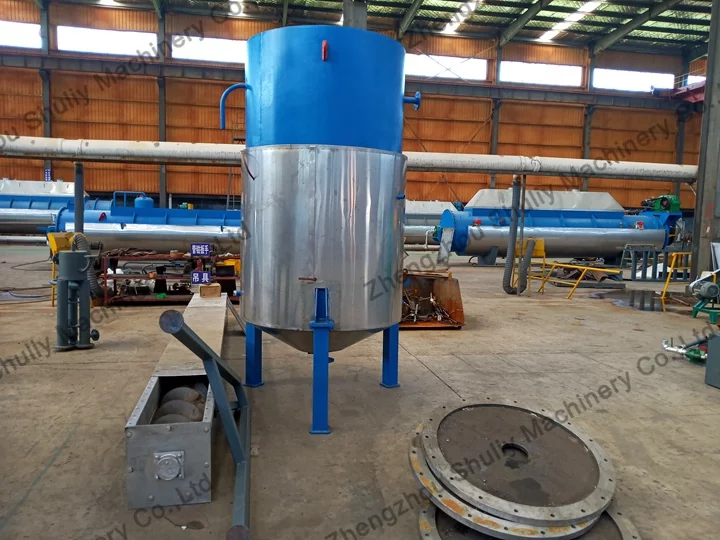
Drying (Drying Machine)
The press cake enters the drying machine, where steam heat is used to evaporate most of the remaining moisture, converting it into a stable dry intermediate product. Waste vapor is treated through a condenser system to ensure clean operation.
A rotary fish meal dryer is used for fast drying with boiler steam as the heat source, continuously processing materials during rotation. The equipment is fully enclosed and equipped with a dust collector to prevent dust leakage.
It adopts steam drying with a jacketed structure. The outer cylinder is made of Q235 carbon steel, and the insulation layer uses alumina silicate with SUS304 stainless steel panels, ensuring good heat retention and energy efficiency.
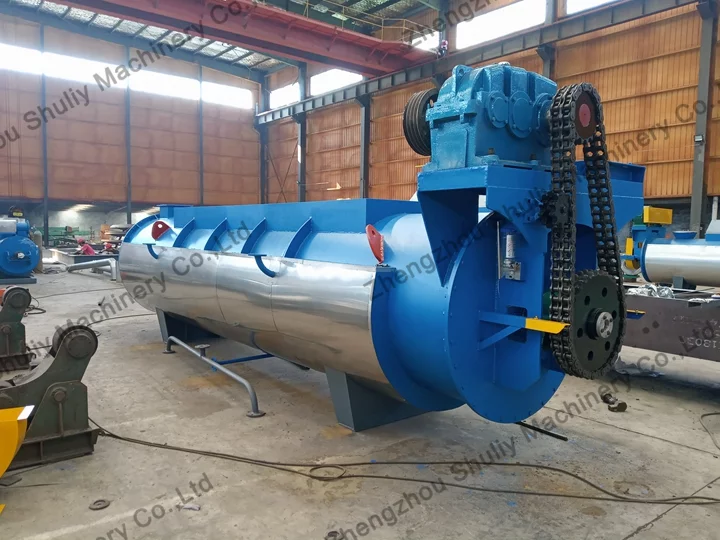
| Model | Tank Size (mm) | Heat Transfer Area (m²) | Evaporation Capacity (kg/h) | Production Capacity (t/h) | Motor Power (kW) | Reducer Model |
|---|---|---|---|---|---|---|
| LH1200 | Φ1200×6000 | 55 | 250-300 | 0.8 | 22 | ZLY250/ZQ650 |
| LH1300 | Φ1300×7000 | 64 | 300-350 | 1.2 | 30/22 | ZLY280/ZQ650 |
| LH1400 | Φ1400×7000 | 81 | 350-400 | 1.4 | 11 | ZQ650 |
| LH1500 | Φ1500×7000 | 106 | 450-500 | 1.6 | 15 | ZQ650 |
| LH1600 | Φ1600×7000 | 120 | 550-650 | 2 | 22 | ZQ650 |
| LH1800 | Φ1800×7000 | 146 | 700-800 | 2.5 | 22 | ZQ750 |
| LH2000 | Φ2000×7000 | 180 | 850-950 | 3.0 | 30 | ZQ750 |
Gas Treatment & Condensation
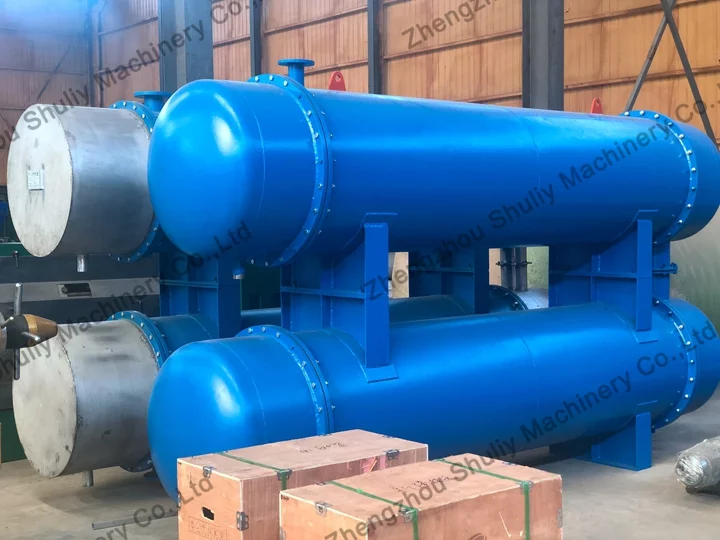
Waste gas and vapor from the drying machine are piped to a condenser, which cools the vapor into liquid using water from the cooling tower and circulating water pool.
The condensed gas then passes through a spray tower to remove odors before being discharged, ensuring environmental compliance.
Post-Processing
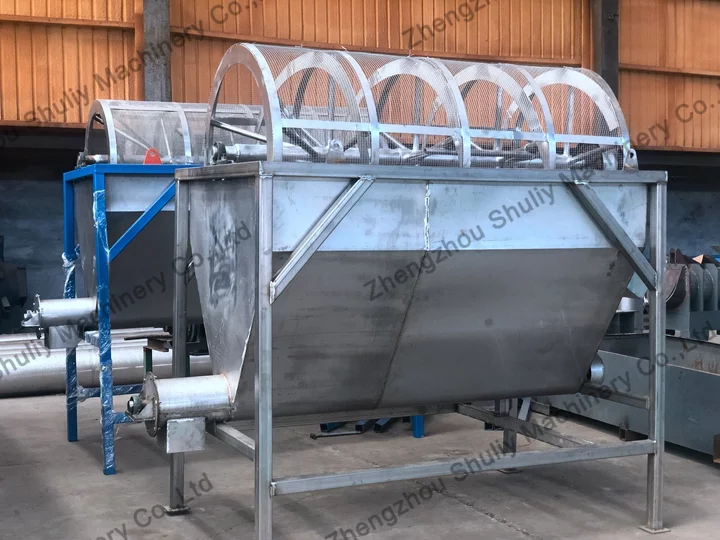
After drying, the fish meal enters the cooling and screening stage to achieve a more uniform particle size and improve final product quality. The drum screening machine cools the fish meal while separating oversized particles, ensuring stable and consistent fish powder output.
The machine supports different screen mesh sizes based on processing requirements and adopts a two-level discharge design. It uses a 5mm × 5mm stainless steel screen mesh, with a Q235B steel bracket and SUS304 stainless steel main body (δ=2mm), providing durability and reliable performance.
Packaging
After spray deodorization, the finished fish meal is conveyed to the packing machine, where it is weighed and packaged into final products for distribution. The fish meal can be packed manually or automatically according to production needs.
An automatic packaging machine is available for efficient quantitative packing, helping improve packaging speed and consistency. Customized packaging options, including logos, brand names, letters, and patterns, can also be supported to meet different market requirements.
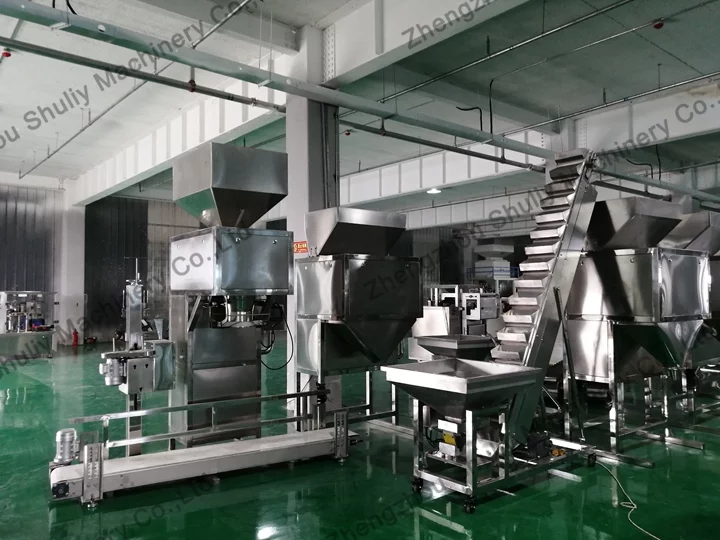
Throughout the entire line, screw conveyors and other material handling equipment ensure smooth, continuous flow, while auxiliary systems like vacuum pumps and storage tanks support the stable operation of the plant. Every machine in the process is designed to maximize yield, preserve nutritional value, and meet environmental standards.
Supporting equipment of the fishmeal making production line
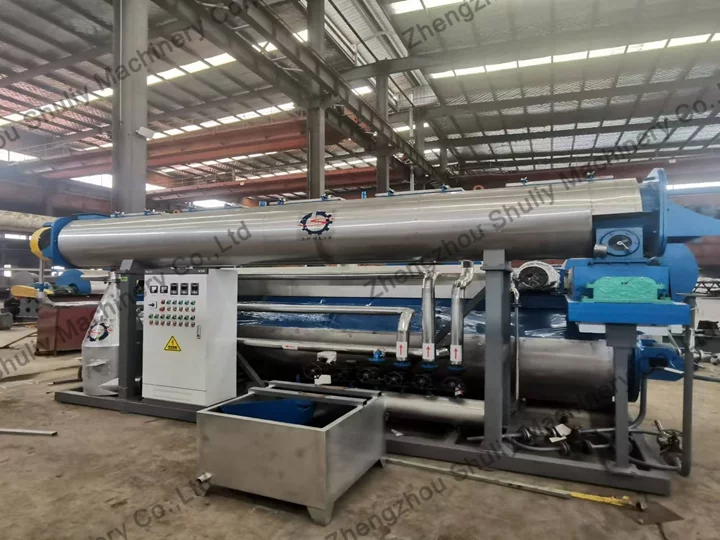
For small-scale fishmeal production, a compact integrated cooker-presser-dryer unit serves as the core equipment, offering an all-in-one solution that combines cooking, pressing, and drying functions to simplify the workflow while maintaining efficiency.
This versatile unit supports two heating methods to adapt to different operational conditions:
- Electric heating: Ideal for small workshops or areas without access to steam infrastructure, it provides precise, instant heat control for consistent cooking and drying temperatures, making it easy to install and operate with minimal setup.
- Steam heating: Suited for scenarios where steam boilers are available, it delivers uniform, high-temperature heat for faster processing, improving energy efficiency and throughput while reducing operational costs for continuous production.
| Model No. | 250kg/h | 500kg/h |
| Raw Material Processing Capacity | 250kg/h | 500kg/h |
| Fish Meal Output Per Hour | 50-60kg/h | 100-125kg/h |
| Fish Oil Output Per Hour | 12.5-15kg/h | 25-40kg/h |
| Fish Meal Yield Rate | 20%-25% | 20%-25% |
| Finished Fish Meal Moisture Content | ≤10% | ≤10% |
| Finished Fish Meal Fat Content | ≤10% | ≤10% |
| Fish Oil Yield Rate | 5%-8% | 5%-8% |
Fish meal machine production line advantages
- High-value final products – Produces premium fish meal with protein content up to 60% or higher, featuring fewer impurities and easy absorption, helping customers gain higher market returns. Extracted fish oil can also be used in cosmetics, pharmaceuticals, and health product industries for added profitability.
- Wide production capacity options – Capacities range from 1–5 tons/day, 10–50 tons/day, 50–100 tons/day, to 100+ tons/day, meeting both small-scale and industrial production requirements. Customized solutions are available based on actual processing demands.
- Environmental protection design – Equipped with dust collection and deodorization systems, including cyclone dust collectors, spray towers, and condensers, helping reduce emissions and support environmental compliance.
- Durable SUS304 stainless steel construction – Key equipment adopts corrosion-resistant SUS304 stainless steel materials, ensuring long service life, durability, and stable operation.
- Customized production solutions – Production lines can be tailored according to raw materials, plant layout, capacity targets, and investment budgets to maximize operational efficiency.
- Comprehensive technical support – Installation guidance, equipment commissioning, operator training, and after-sales service are provided to help ensure long-term and reliable production performance.
Conclusion
The fish meal machine is an efficient solution for converting fish, seafood by-products, and marine waste into valuable fish meal and fish oil, helping businesses improve raw material utilization and increase profits. With flexible capacities, durable materials, environmental protection systems, and customized production solutions, it can meet the needs of different processing scales.
If you are looking for a reliable fish meal production solution, contact us today for machine details, technical support, and a customized quotation. Our team is ready to help you build an efficient and profitable fish meal processing business.